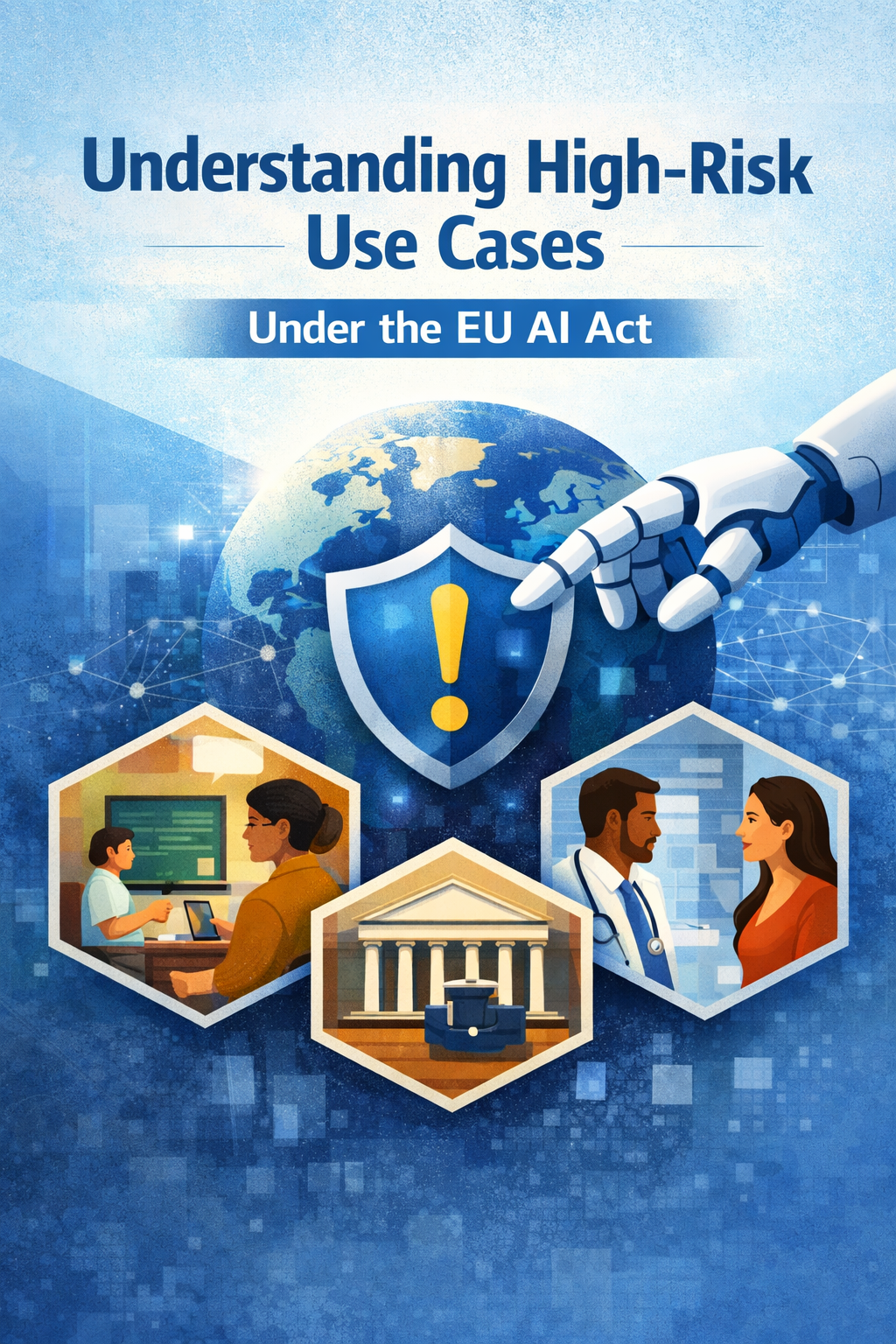
Shadow AI & High-Risk Drift: Detecting Exposure Before It Becomes Liability
Shadow AI & High-Risk Drift: Detecting Exposure Before It Becomes Liability
No se pudo cargar la disponibilidad de retiro
Learn to recognise hidden AI risk and organisational drift under the EU AI Act.
So many organisations believe they know where AI is being used? But, they may be wrong.
Under the EU AI Act, risk is triggered by impact, not necessarily by intent, approval, or procurement process.
This course is a risk-detection and responsibility-clarification tool for leaders accountable under the EU AI Act.
Grounded in the EU AI Act’s logic, the course prepares leaders with risk recognition skills that apply across regulatory contexts. Its focus is not on policy summaries or vendor classifications. Instead, it explores how risk actually emerges inside real organisations: through everyday decisions, informal tool use, and unexamined assumptions.
Specifically, the course:
- Identifies decision drift, when AI use quietly shifts into high-risk territory
- Surfaces unintended high-risk classification, especially where tools were never formally approved
- Treats Shadow AI as an operational reality, not a compliance failure
Participants develop the ability to:
- Ask where AI is actually being used and not just where it is “approved”
- Link high-risk classification to function, impact, and context, beyond vendor labels
- Recognise that unauthorised AI use can still trigger EU AI Act duties
This is drift detection through critical and aware thinking, and that is the ideal starting point for responsible governance.
The course helps leaders recognise drift in everyday decisions, before it becomes formal risk. Because recognising drift early is the first step in preventing unintended high-risk exposure.
By the end of the course, participants can:
- Spot high-risk AI without technical or engineering access
- Identify where Shadow AI already breaches EU AI Act obligations
- Escalate risk in defensible, regulator-ready language
- Answer the question boards eventually ask: “Are we exposed?”
This course is especially valuable for:
- Non-technical leaders
- Compliance, legal, HR, and procurement teams
- Boards and senior executives responsible for AI accountability
Technical leaders can also use this to stress-test assumptions, spot governance gaps, and translate risk into board-ready language. While grounded in EU AI Act logic, these risk recognition skills apply broadly to organisations managing AI risk.
The course is designed to be completed in 2.5–4 hours, with optional reflection and scenario prompts for deeper engagement.
The reality is simple: drift is inevitable, but unmanaged drift creates liability.
It is designed to be completed:
- In short, focused sessions
- Or in one extended sitting for strategic teams
To get the most value:
- Approach this course as a risk-recognition exercise, not a checklist
- Apply the questions to your actual tools, workflows, and decisions
- Pause where discomfort appears; it is often where drift already exists
This is not a course to rush. The most rewarding aspects come through clarity, not speed.
For organisations ready to move from recognition to formal evidence, this course provides the foundation for more advanced governance and assurance tools.
Part of CKC Cares’ human-first approach to AI governance, supporting safer, fairer, and more accountable technology in practice.
Share